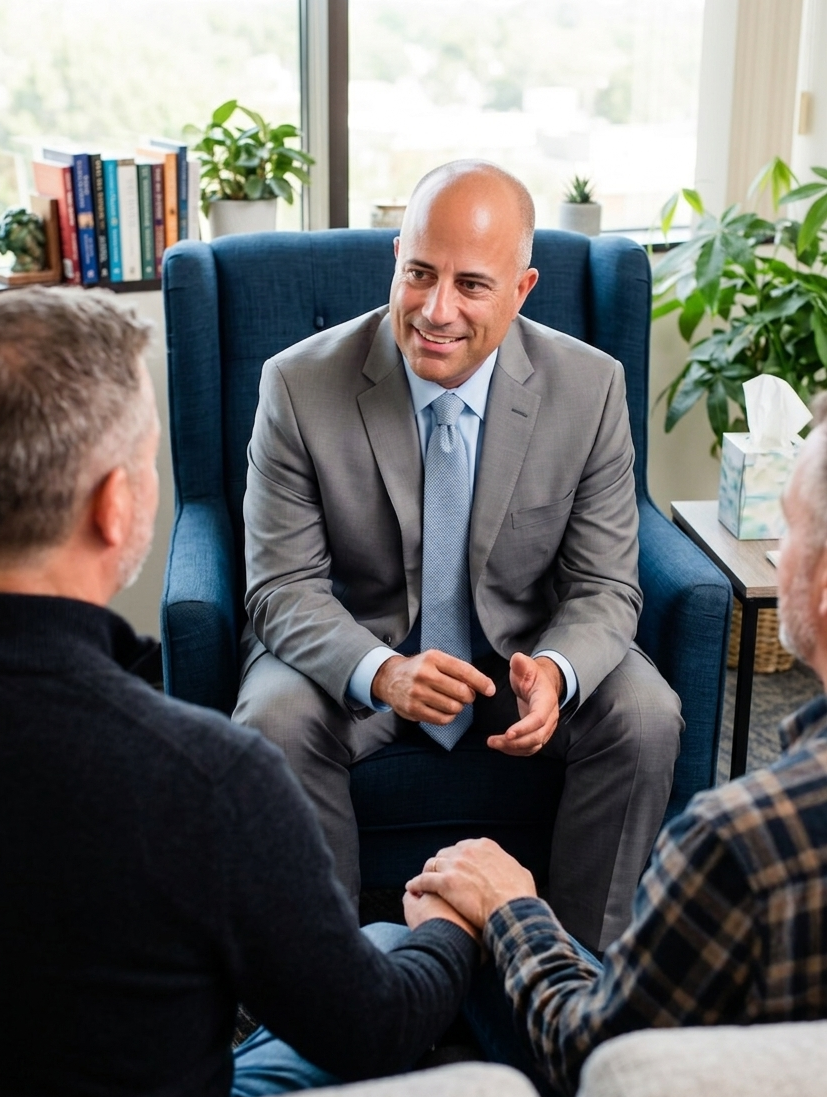
LGBTQ+ couples therapy — exclusively.
Why I do this work
I came to this work the way most people come to the things that matter most — through my own life.
I'm a gay man, married to my husband for many years, and I know in my bones what a strong relationship makes possible. It is the foundation on which everything else is built. When that foundation cracks — when couples come to me feeling stuck, distant, or unsure — I don't treat it as a problem to be managed. I treat it as the most important work there is.
LGBTQ relationships deserve better than what most therapy has offered them.
For too long, LGBTQ+ couples have walked into therapists' offices and found themselves doing two jobs at once: working on their relationship and quietly explaining the basics of queer life to someone who was supposed to be helping them. That exhaustion is real. It is also entirely unnecessary.
This practice exists to end that dynamic. When you sit across from me, you will never be someone's learning experience. I understand minority stress — the cumulative weight of living in a world that has not always been built for you — and how profoundly it shapes what happens inside a relationship. I understand chosen family, and why its fractures can feel just as devastating as any biological loss. I understand that coming out is not a single moment but an ongoing, lifelong negotiation with the world, and sometimes, with each other.
My approach draws on the Gottman Method—one of the most rigorously researched frameworks in couples therapy— always adapted through an affirmative, queer-informed lens.
I don't apply the model mechanically. I use it as a foundation for understanding the particular shape of your attachment, your conflict, and your longing.
I also work with the body. Emotion lives in us physically before it ever becomes language, and some of the most powerful moments in therapy happen not when something is said, but when something is finally felt. I create space for that.
Above all, I work toward an endpoint, not a dependency. My goal is not to keep you in therapy indefinitely. It is to give you a language, a set of skills, and a renewed sense of each other that you carry well beyond our sessions — for the rest of your life together.